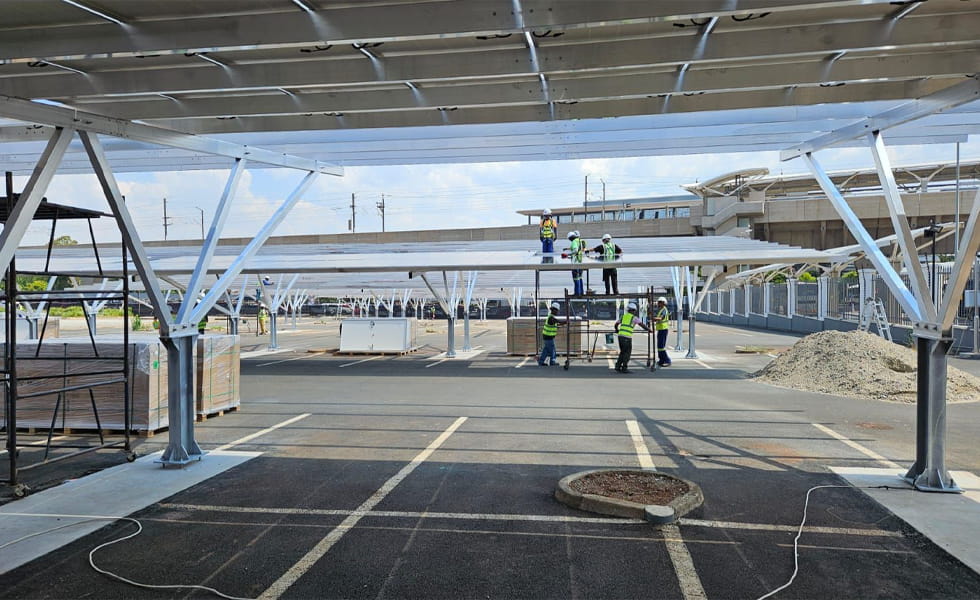
On November 1, in the Kangping Community of Sajin Subdistrict, Xingyi City, Guizhou Province, resident Yang Congxuan stood beneath a photovoltaic (PV) carport, looking up at the solar panels overhead. "It’s much better now—my vehicle is protected from both the sun and the rain," she remarked. Previously, vehicles parked in the open were constantly exposed to the elements; now, the solar panels on the roof serve as a protective canopy, while the parking area itself has taken on a new identity: a small-scale power plant.
As sunlight hits the carport, the generated electricity is fed into the power grid, translating into tangible revenue. The project, which involved a total investment of 2 million yuan and has an installed capacity of 0.4 megawatts, officially went into operation this January. It is projected to generate 440,000 kilowatt-hours of electricity this year, yielding an estimated 120,000 yuan in revenue. By the end of September, it had already contributed 90,000 yuan to the community’s collective economy. Of the 47,200 yuan earned between January and June, 20%—amounting to over 9,000 yuan—was distributed as dividends to households that had previously emerged from poverty; these payments were fully disbursed by September 30. The remaining 30,000-plus yuan was added to the collective economic fund.
A parking structure in a residential resettlement community now generates over 100,000 yuan annually for the collective, while also providing dividends to households that have escaped poverty—a scenario that would have been unimaginable just a few years ago.
01. What exactly is a photovoltaic (PV) carport?
When people first encounter a PV carport, their initial thought is often, "Oh, they’ve just mounted some solar panels onto a carport." That is only half the story.
Strictly speaking, a PV carport is not merely an add-on to an existing structure. Instead, it is a distributed, low-voltage, grid-connected power plant where a steel or aluminum-alloy truss system replaces the traditional roof, with solar panels installed directly onto it. The space underneath remains available for parking, while the roof simultaneously generates electricity. Such projects must undergo a full formal process—including registration, grid connection, and inspection—making their approval requirements essentially the same as those for rooftop solar installations on commercial or industrial buildings.
The type most commonly found in community projects is the standard truss-style PV carport, rather than BIPV (Building-Integrated Photovoltaics). The difference between the two lies in their construction: for standard photovoltaic (PV) carports, the structure is built first, by the installation of PV panels—a process that is both cost-effective and rapid. In contrast, Building-Integrated Photovoltaics (BIPV) utilize PV modules as actual building materials; this approach entails higher unit costs and more complex construction techniques, making it generally unsuitable for community-level projects.
Compared to rooftop PV systems, PV carports incur additional costs for structural load-bearing and waterproofing, but they also save on the expenses for traditional roofing materials, such as color-coated steel tiles or polycarbonate sheets. When the total costs are tallied, the unit cost is quite similar to that of rooftop PV installations.
Ultimately, the profitability of a PV carport is determined not by the panels themselves, but by how the generated electricity is sold. According to the "Administrative Measures for the Development and Construction of Distributed Photovoltaic Power Generation," issued by the National Energy Administration in January 2025, there are three operational models for distributed PV: full grid-injection (selling all power to the grid), full self-consumption (using all power on-site), and self-consumption with surplus power fed into the grid. Non-individual entities—such as village collectives or residential communities—may choose any of these three. Notably, electricity used on-site is billed at local commercial/industrial or collective residential tariff rates, which are significantly higher than the benchmark coal-fired power price applied to surplus electricity sold to the grid.
02. Where does the demand for PV carports come from?
On one hand, there is demand from residential communities and village collectives. Many relocated communities and older residential areas feature large, open-air parking lots that suffer from intense sun exposure in the summer and water accumulation during rain—issues that property management companies are often unwilling to fund repairs for. Simultaneously, these village collectives and relocated communities frequently lack robust operational assets; they struggle to find stable revenue streams to fund dividends for residents or support public services.
On the other hand, there is demand from the PV industry itself. Following a period of explosive growth, the residential PV market has seen a marked slowdown in new installations. Meanwhile, commercial and industrial rooftops have been extensively tapped by major developers, making high-quality rooftop resources increasingly scarce. As rooftop space becomes exhausted, the industry has begun looking elsewhere—revisiting "secondary" sites such as carports, parking lots, charging stations, and vacant land within industrial zones.
The advantage of carports is that they represent one of the few types of underutilized urban space that are flat, south-facing, non-intrusive to residents, and do not require the occupation of additional land. The demand for parking and the demand for power generation are superimposed within the same space—requiring no additional land and leaving the original function of the site unchanged.
For a community, this represents an "overhead asset" that requires no major construction, no relocation of residents, and no additional land acquisition. For the industry, it offers a new, untapped market segment following the saturation of the residential (rooftop) solar sector.
03. Representative Projects
Even among photovoltaic (PV) carports, the rates of return can vary significantly.
For instance, the Dongshan Cooperative in Changsha benefits from its proximity to urban power demand, generating an annual rental income of 560,000 yuan. In Funing Village, Ningxia, a small-scale PV carport earns the collective 25,000 yuan annually (including savings on electricity costs). Meanwhile, the Kangping Community in Xingyi sees an annual return of approximately 120,000 yuan—a mid-range figure. The key factors driving these differences are not the number of solar panels, but rather three elements: the price of electricity for self-consumption, the presence of flexible loads (such as EV charging stations) beneath the structure, and who covers the initial investment.
If a carport is used solely for parking, the proportion of self-consumed electricity remains low; most of the power must be sold back to the grid, which naturally reduces potential earnings. Conversely, if the carport is equipped with EV charging stations—or if there are other public electricity loads within the village—the power can be "sold" for self-consumption at a higher effective price, completely changing the financial outlook.
Take the PV carport project in Kangping Community as an example. In 2024, the community launched this initiative using central government subsidies earmarked for rural revitalization. It is constructed and operated by the community’s collective enterprise, Xingyi Kangzhiping New Energy Co., Ltd., and officially began operations this January. With a total investment of 2 million yuan and an installed capacity of 0.4 megawatts (MW), the project was built over an existing parking lot, requiring no new land.
The facility generates 440,000 kWh of electricity annually, with an expected yearly return of 120,000 yuan; as of the end of September, it had already generated 90,000 yuan in additional revenue. These figures reveal several key insights.
First, with an annual output of 440,000 kWh from a 0.4 MW capacity, the system achieves approximately 1,100 annual utilization hours. Xingyi is located in the Qianxinan Prefecture of Guizhou Province. With solar irradiance levels ranking in the upper-middle tier for the province, a distributed photovoltaic (PV) system here typically yields 1,000–1,100 annual utilization hours. For a 0.4 MW system, 1,100 hours of operation results in an annual output of 440,000 kWh—a realistic figure based on local resource conditions.
Second, with an annual revenue of 120,000 yuan against an output of 440,000 kWh, the effective price is approximately 0.27 yuan per kWh. This indicates that the project operates under a "full feed-in" model: all electricity generated is sold to the grid and settled at the local benchmark price for coal-fired power. There is no on-site consumption to boost the blended electricity price, which is the fundamental reason for the project's thin profit margins. If the space beneath the solar canopy were utilized for facilities like EV charging stations or communal power needs—allowing a portion of the electricity to be consumed on-site at commercial or industrial rates—the revenue per kWh could reach 0.6–0.8 yuan.
Third, a total investment of 2 million yuan for a 0.4 MW system translates to a cost of approximately 5 yuan per watt. While the typical EPC (engineering, procurement, and construction) cost for commercial and industrial distributed PV projects currently ranges from 2.5 to 3 yuan per watt, the cost for a solar canopy project is nearly double. This is understandable: such projects require independent steel structures, must account for wind and snow loads as well as drainage, and necessitate foundation modifications to existing parking areas. Furthermore, the 0.4 MW scale is insufficient to effectively amortize these fixed costs. Based on an annual revenue of 120,000 yuan, the static payback period is approximately 16–17 years—significantly longer than the 6–8 years typical for standard commercial and industrial PV plants.
However, evaluating this project solely based on a commercial payback period misses the point. The 2 million yuan investment is funded by central government subsidies earmarked for rural revitalization; the community is not required to raise these funds, meaning the burden of the long payback period does not fall upon them. More importantly, this investment secures more than just a 0.4 MW power plant—it also provides a canopy that shields vehicles from sun and rain. The electricity revenue serves as an additional benefit, while the canopy itself functions as a piece of essential public infrastructure. A single investment yielding two types of assets—this is the fundamental distinction between a photovoltaic (PV) carport and a standard rooftop solar power plant.
For the PV industry, as the residential rooftop market reaches saturation, "downstream" settings—such as residential communities, villages, and parking lots—are emerging as new sources of growth. For local neighborhood or village collectives, this represents an operational asset with a relatively low entry barrier, clear property rights, and the potential for direct financial returns to residents. For car owners, the most immediate benefit is that their vehicles are no longer exposed to scorching sun while parked.
The PV carport project in Kangping Community—supported by government transition funds, utilizing a "full feed-in" model (selling all generated electricity to the grid), and distributing 20% of the revenue as dividends—is well-suited for resettlement communities with limited capital and no significant on-site electricity demand. If a community already has EV charging stations or public power consumption, it can leverage "self-consumption" (using the generated power on-site) to generate higher returns from the same 0.4-megawatt capacity. Alternatively, if a community lacks the capacity for independent operation, it can simply lease the roof space to a professional firm in exchange for rent—a safe and reliable approach. None of these paths is inherently superior; the best choice simply depends on the resources the community has at its disposal.